

An analysis conducted by AJW for Climate Innovation Projects of 2023 California Air Resources Board (CARB) emissions inventory data for large (>25,000 metric tons CO₂e) Cap-and-Invest facilities eligible for MDI (“MDI-eligible facilities”) suggests that the program could support efforts to reduce tens of millions of metric tons of annual greenhouse gas (GHG) emissions, thousands of tons of nitrogen oxides (NOx), and substantial quantities of toxic air contaminants (TAC). Nearly 70 percent of MDI-eligible facilities are located in California Environmental Protection Agency (CalEPA) designated disadvantaged communities (DAC).1
California Can Lead on Industrial Investment
Industrial facilities eligible for the MDI are generally high “leakage risk”, meaning they compete in the global market and are therefore price sensitive (i.e., unable to pass the cost of decarbonization off on to their customers). Decarbonizing complex and often bespoke industrial sources presents a significant economic challenge. Cement, refining, food processing, and other MDI eligible sectors run equipment such as kilns, boilers, furnaces, and process heaters that can last for decades. Lower-carbon alternatives exist for many of these sources, but they are frequently more expensive than existing equipment and may require significant capital for infrastructure upgrades.
Even when a project can significantly reduce a facility’s covered GHG emissions in California’s Cap-and-Invest program, the savings from avoided allowance purchases may not cover the capital and operating costs of the investment. Today, at allowance prices at approximately $30 per ton of CO₂, many alternative technologies and solutions are still cost prohibitive. This is why CARB made decarbonization solutions that remain more expensive than the carbon allowance price, like electrification, low carbon intensity hydrogen, biomass, and carbon management eligible for the MDI program. The MDI allows California industries to make investments in decarbonization projects they could not invest in otherwise. That is the economic rationale for MDI.
MDI is the tool that lets California close the gap. It is a means for keeping investment, jobs, and lower-emitting manufacturing inside the state. Without the incentive, businesses may continue operating higher-emitting equipment, defer major capital investments, or relocate their production outside of California.
The Industrial Emissions Opportunity Is Substantial
An analysis conducted by AJW for Climate Innovation Projects identified 116 MDI-eligible industrial facilities, each reporting at least 25,000 metric tons of GHG emissions (CO₂e) annually. Together, these facilities account for approximately 52.4 million metric tons per year (TPY) of covered GHG emissions, about 61 percent of covered GHG among large facilities in the dataset.
52.4M
metric tons per year of covered GHG emissions reported by 116 MDI-eligible industrial facilities.
Their emissions also extend far beyond carbon dioxide. The MDI-eligible industrial facilities also report NOx, particulate matter (PM), and toxic air contaminants (TACs), including acrolein.
The inventory spans food and beverage, cement and minerals, chemicals, paper, metals, petroleum refining, and oil and gas operations. These industries produce essential goods, employ workers across the state, and face capital decisions that will determine whether their next investments happen within California.
The MDI May Also Support Investment in Local Air Pollution Emissions Reductions
GHG emissions occur wherever fossil fuel is burned. Combustion sources at these facilities can also emit criteria air pollutants and TACs, depending on the equipment type and fuel. MDI has the potential to reduce local air pollution depending on the equipment or fuel switching efforts that occur.
Our analysis found that 80 of the 116 MDI-eligible facilities are located in CalEPA designated DACs, based on the September 2026 DAC designations. Additionally, 89 percent (103) of MDI-eligible facilities are in areas that are in nonattainment with National Ambient Air Quality Standard (NAAQS), and 62 percent (72) are in areas classified as extreme nonattainment.
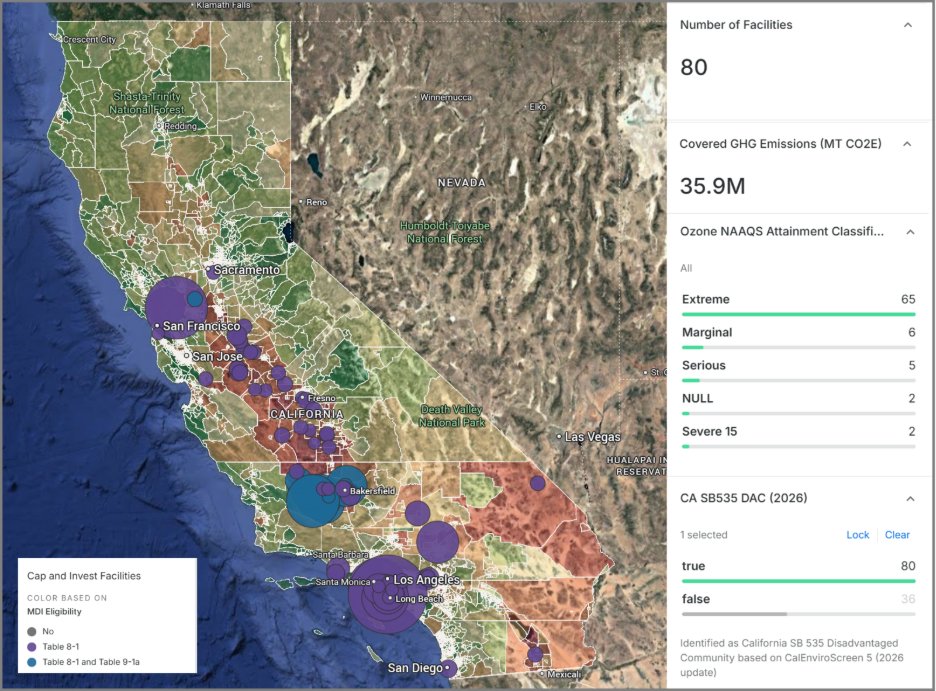
A closer look at the 80 facilities in DACs reveals that these facilities emit a substantial percentage of the emissions covered by MDI.
| Emissions | All MDI-eligible facilities (TPY) | MDI-eligible facilities in DACs (TPY) | Share in DAC areas |
|---|---|---|---|
| Covered GHG | 52.4 million MT | 35.9 million MT | 69% |
| NOx | 17,093 tons | 6,360 tons | 37% |
| PM2.5 | 3,146 tons | 1,498 tons | 48% |
| Diesel PM | 43,883 lb | 13,449 lb | 31% |
| Acrolein | 5,987 lb | 4,160 lb | 69% |
Among the large eligible facilities in those communities, food and beverage manufacturing (28 facilities), refineries (12), and oil and gas production (12) are the three largest sectors by count.
California has an opportunity to use MDI not merely as a carbon program, but as a tool for delivering substantial climate and local air quality benefits.
Trends in Equipment Types Reveal Potential Project Opportunities
Industrial emissions are not distributed evenly across equipment.
Utilizing NOx as a proxy for combustion-related emissions, we evaluated the equipment types, and how many pieces of equipment are emitting emissions at each MDI-eligible facility. We broke the facilities into three groups, depending on how many pieces of equipment were combustion emission sources:
- Concentrated: Over 70% of the facility’s total NOx emissions from a single source
- Mixed: Between 30% – 70% from a single source
- Distributed: Less than 30% from a single source
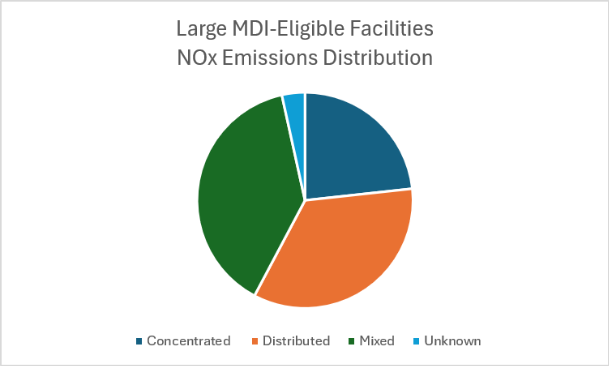
Concentrated facilities may have just a few pieces of equipment that are producing the majority of emissions. Concentrated NOx was more common in cement, flat glass, and paperboard production. There are 27 such facilities with concentrated emissions from a small number of sources:
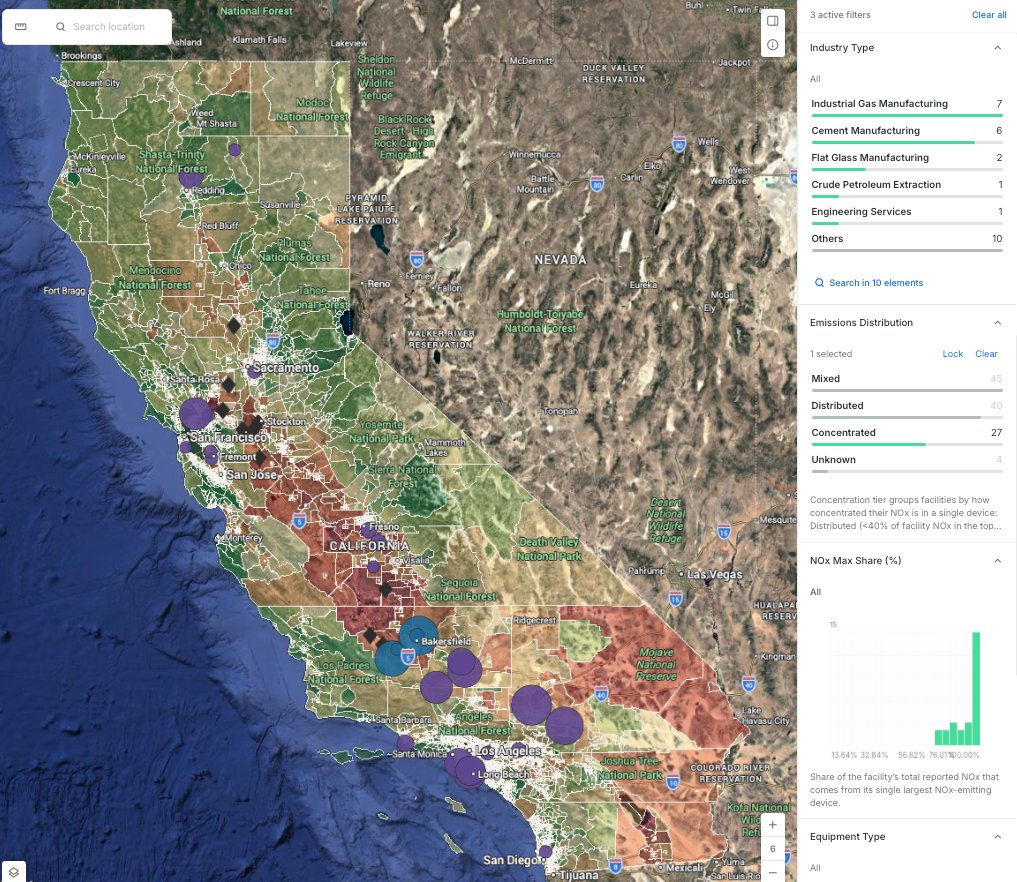
Other facilities have emissions distributed across many pieces of equipment. Distributed and mixed NOx was more common in food and beverage, petroleum refining, and metals production.
This means that some facilities can remove a large share of NOx, and often co-emitted GHGs, by changing one major combustion source. Others will need a portfolio of smaller projects. MDI does not have to choose between those paths in advance.
The Economics Explain Why Incentives Matter
California’s carbon price alone cannot be assumed to close the gap. With allowances settling between roughly $29 and $32 in recent auctions, a project that avoided 100,000 MT of covered GHG emissions would save on the order of $3 million a year in allowance purchases.
For a capital-intensive project costing tens or hundreds of millions of dollars, that revenue-equivalent benefit may be insufficient. MDI is designed to help close that gap. By directing Cap-and-Invest allowance value to on-site projects, it can make the capital outlay viable at facilities that would otherwise keep running existing equipment or defer the decision. That is how California keeps the next equipment cycle – and the jobs and production attached to it – inside the state.
Federal experience points in the same direction. A September 2026 ACEEE review of the Department of Energy’s Industrial Demonstrations Program found that the program’s subsector- and solution-agnostic design was a strength: applicants could combine efficiency, electrification, fuel switching, and other strategies rather than fit a single template.1 That flexibility better matched how industrial sites actually make capital decisions. California’s MDI is built on the same premise. The device-level inventory shows why it matters here: some facilities can move a large share of emissions at one combustion source, while others need a portfolio of smaller projects.
What the Data Supports
MDI-eligible facilities already report about 53 million MT of covered GHGs, along with substantial NOx, PM, diesel PM, and acrolein. Nearly 70 percent of those facilities are in DACs, and most are in ozone nonattainment areas. At some sites, most of the NOx comes from a single combustion source. At others, it is spread across many.
That range is the case for a broad, flexible program. A cement kiln, a food-sector boiler, and a refinery heater are not the same project. Flexibility lets facility managers bring the investment that fits each site’s decarbonization goals and design limits. Because those pollutants are already reported at the same equipment, the project that decarbonizes the kiln, boiler, or heater is also the project with a local emissions benefit in reach. MDI’s value is that it can back that investment without deciding the technology in advance.
- Based on the September 2026 version of the SB 535 DAC census tracts in alignment with the publication of CalEnviroScreen 5.0. ↩︎
- ACEEE, Lessons from DOE’s Industrial Demonstrations Program ↩︎